24.11.2026
An unpredictable boss and no strength left: how to keep clarity
Ekvilibro Journal · Business crisis
How to keep clarity in difficult management environments and always stay ahead
An interview with Elena Lvova, author of the Ekvilibro system, crisis management consultant
In short. Next to an unpredictable leader it is easy to slip into the role of victim: “I put up with it because it pays”, while the price is paid in health. Clarity returns when the situation is seen as a whole — as a system with its inputs, outputs and cost.
Interviewer: Elena, you like making up puzzles. How does that relate to your practice?
Elena Lvova: Yes, I enjoy taking complex structures apart. In work with senior executives this is especially useful: their situations almost always look like a dead end, but in fact they are a system with inputs, outputs and a cost. You just need to see it as a whole.
Interviewer: Say a senior manager comes to you who works under an aggressive boss. What do you see?
Elena Lvova: A typical trap. On the one hand, the client suffers from senior executive syndrome: constant tension, burnout, losing themselves. On the other, they receive above-market pay and perks for their suffering. This is not a hypothetical story. I know such a person: he is forced to carry out all of his boss’s orders — otherwise he will be seen as unnecessary — and he is gradually losing his eyesight from the constant strain.
Interviewer: What is the main trap?
Elena Lvova: That a person starts to identify with the role of victim. They think: “I put up with it because I am paid.” But in fact they are the one paying — with health, clarity, years of life. And often they do not notice that they stopped choosing long ago and are simply reacting.
Interviewer: If a client asks, “What would you do in my place?”, what do you say?
Elena Lvova: I would get the most out of contact with a boss like that. But not in order to endure it. In order to see the system as a whole, keep my clarity and leave it with resources.
Interviewer: What does “get the most out of it” mean?
Elena Lvova: It is not about revenge or cynicism. It is about sober calculation. While you are inside the system, take what it can give: money, connections, an understanding of how power works, access to information. But above all, use this environment as a training ground for developing yourself. Learn to see the boss’s triggers, the rules of the game, your own role. That is strategic clarity.

Interviewer: Doesn’t that sound like justifying abuse?
Elena Lvova: No, and the boundary matters here. Normalising abuse is when a person stays and calls it growth. My position is different: use contact with a tyrant as material for clarity, but do not turn it into a way of life. Understanding without a way out is sometimes the worst kind of blindness. That is why in our work we always keep one question in view: “What will you have when you leave?”
Interviewer: What is Ekvilibro?
Elena Lvova: It is a technology for keeping the balance between benefit and self-destruction in a toxic environment. Not escape, not victimhood, not cynicism. It is a way to remain the one who acts when everything around is pressing down. Ekvilibro helps you avoid falling into the role of either victim or executioner, hold the centre and act from clarity.
Interviewer: What does the client get as a result?
Elena Lvova: A tool for seeing the game as a whole without dissolving in it. In business language, it is systems thinking, the observer’s meta-position, managing emotional resilience and breaking power down into its parts. The client begins to understand what the boss’s power is made of, where its limits are and where their own lie. That is more honest and more practical than the promise of a miracle.
Interviewer: Is it about staying or leaving?
Elena Lvova: It is about choice. First, to see. Then, to decide. Sometimes it pays to stay for a while and take the resources. Sometimes, to leave. But it is better to leave not on emotion or out of despair, but from clarity. Then it is not an escape but a carefully calculated strategic decision.
Interviewer: Who is this kind of work not suitable for?
Elena Lvova: People in acute crisis, with serious health problems, a severe mental disorder, or a threat to their life. They need a different kind of help. My work does not replace therapy or safety. It is consulting for those who have the resources and a task: to take the system apart, not merely to survive.
Interviewer: How can someone book a consultation with you?
Elena Lvova: If you would like to talk it over, get in touch. There is a well-tested technology, and special terms for regular clients. About consultations →
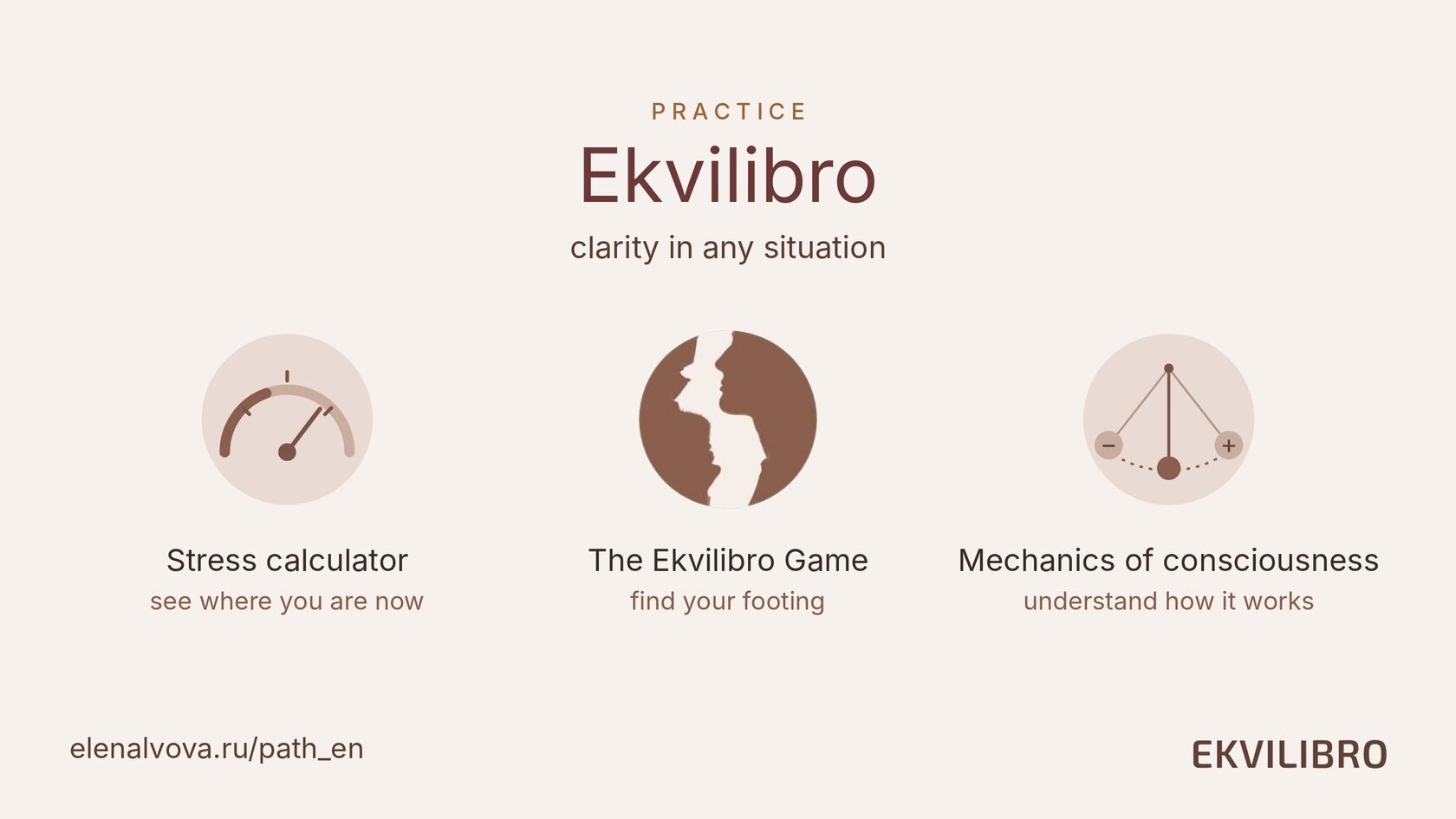
Ekvilibro Practice
Stress calculator: how much strength the changes of the past year have taken.
The Ekvilibro Game: simple steps to notice automatic reactions and find stability.
Mechanics of consciousness: why reactions repeat and how to choose your state.
Online. No sign-up.
About the author
Elena Lvova is the founder and head of the Ekvilibro center, author of the Ekvilibro system, crisis management consultant and psychologist. 15 years in management and consulting. Author of 12 books (in Russian) and more than 30 scientific and practical papers, from psychology and economics to crisis management and conflict studies.
ORCID iD: 0009-0007-3069-9106
elenalvova@ekvilibro.ru
elenalvova.ru/en
Read also