24.11.2026
A company’s crisis hits its leader, and the leader’s state hits the company
Ekvilibro Journal · Business crisis
An interview with Elena Lvova, author of the Ekvilibro system, crisis management consultant
In short. A company’s crisis and its leader’s crisis set each other off, so it makes sense to work on both sides at once. A company’s resilience begins with the resilience of the person who makes the decisions.
— Elena, you talk about “two sides of one crisis”. What does that mean?
— A crisis is rarely only financial or only personal. When a company loses its stability, so does the person who holds it together. That is why I work with both sides of the same crisis, the outer and the inner. Usually they are handled by different specialists: financiers and lawyers work with the company, psychologists with the person. I have seen how one side drags the other along, so I work with both.
— Where did you see that?
— In crisis management. I came to it as PR director of an industrial holding company, later headed GR and crisis projects, and reported directly to owners and CEOs. We set up management accounting, restructured debt, negotiated with creditors and brought companies back from the brink of bankruptcy. And again and again I saw the same pattern: a company’s resilience begins with the resilience of the person who makes the decisions.
— And how did you get from crisis management to philosophy and psychology?
— When I started working as a crisis manager, I discovered something interesting. People who were pleasant and easy to deal with at first would suddenly turn their backs and let you down. And those with whom there was nothing but friction and conflict at the start would, over time, become allies. That surprised me, and I wanted to understand why it happens.
I found the answer in philosophy and psychology. Today I have no expectations of people. Whether someone is facing me or has turned their back, I will gain something from it either way.
— What happens when the person at the top loses stability?
— Decisions start to swing. Today, cut everything; tomorrow, invest in everything. Today, total control; tomorrow, “do what you like”. It is a pendulum, and the team swings along with the leader. The numbers may be in order, and the company still stalls.
— So what is the answer: calm the leader down?
— No. The task is not to dampen the swings. A crisis always means a wide range: growth and decline, risk and caution. Anyone who builds a business lives with that range all the time. What matters is who controls the pendulum: the person, or the pendulum controls them. In the Ekvilibro method this is the Observer position: a point from which both edges of the situation and the whole space of options between them are visible. From there, decisions stop lurching.
— Why not simply see a psychologist?
— A psychologist helps you understand your feelings and your past. A coach helps you set goals and grow. But when things are on fire here and now — a deal has fallen through, creditors are pressing, shareholders are in conflict — you need someone who understands both the numbers and the people. A person whose company is collapsing does not want comfort. They need a tool that works and a partner who speaks to them as an equal.
— What does working with a company look like in practice?
— We start with an audit: in 10 working days we find the real causes of the losses — in finance, processes, the management team, conflicts. Then it depends on the task: a strategic session to align senior management, or support until the plan for getting out of the crisis starts to work. In parallel, there is work with the person at the top, because without their stability any plan falls apart.
— And if the crisis is personal: divorce, job loss, burnout?
— The mechanics are the same. A person swings between poles: “I can handle anything” and “all is lost”, anger and helplessness. The steadier the Observer position, the wider the swing a person can withstand. Without it, even a trifle can knock them off course for a long time. So we do not look for someone to blame; we give the person back control. And we give them a tool they can use on their own.
— Where should someone start if they are not sure they need this?
— With a first consultation, to look at the situation and understand which format fits and whether one is needed at all. Sometimes after it a person sees the first step for themselves and manages from there. That is a good result too.
— And in a word?
— There is one crisis, and it has two sides. To get out of it, you need to see both.
If your company, or you yourself, are going through a crisis, a consultation is a way to look at your situation together. More →
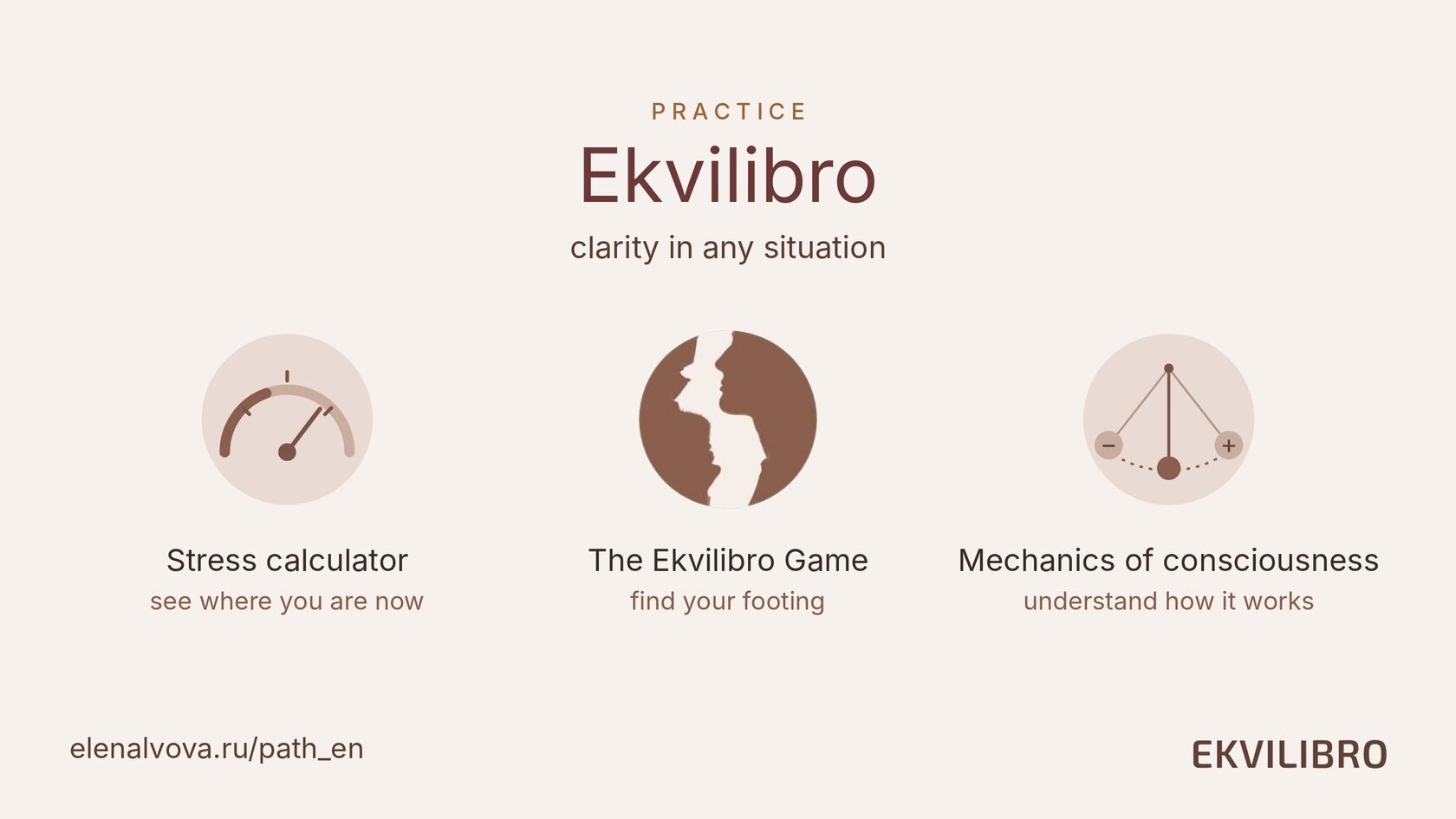
Ekvilibro Practice
Stress calculator: how much strength the changes of the past year have taken.
The Ekvilibro Game: simple steps to notice automatic reactions and find stability.
Mechanics of consciousness: why reactions repeat and how to choose your state.
Online. No sign-up.
Stress calculator: how much strength the changes of the past year have taken.
The Ekvilibro Game: simple steps to notice automatic reactions and find stability.
Mechanics of consciousness: why reactions repeat and how to choose your state.
Online. No sign-up.
About the author
Elena Lvova is the founder and head of the Ekvilibro center, author of the Ekvilibro system, crisis management consultant and psychologist. 15 years in management and consulting. Author of 12 books (in Russian) and more than 30 scientific and practical papers, from psychology and economics to crisis management and conflict studies.
ORCID iD: 0009-0007-3069-9106
elenalvova@ekvilibro.ru
elenalvova.ru/en
Read also