24.11.2026
A company is no steadier than its leader: psychology as crisis management
Ekvilibro Journal · Business crisis
An interview with Elena Lvova, author of the Ekvilibro system, crisis management consultant and psychologist
In short. Inside every person there is a whole organisation, much like a company, and in times of uncertainty its departments start to fight. A good psychologist is essentially a crisis manager, and a company’s resilience begins with the resilience of its leader.
— Elena, business people are often wary of psychology. Owners, senior managers and entrepreneurs are used to solving problems, not complaining about them. They keep their distance from psychology but respect logic, frameworks and numbers. What would you say to that?
— A long-time friend of mine, the owner of a chain of serviced apartments, shared that view. I suggested he look at a person as a company. Our inner organisation is much like a legal entity. There are founders and a director, deputies and managers, departments and units. And a great many staff — in psychology they are called subpersonalities. In a word, a whole organisation inside one person. As for psychology and psychologists, a good specialist is at heart a crisis manager. If you are very lucky, you will find one.
— A long-time friend of mine, the owner of a chain of serviced apartments, shared that view. I suggested he look at a person as a company. Our inner organisation is much like a legal entity. There are founders and a director, deputies and managers, departments and units. And a great many staff — in psychology they are called subpersonalities. In a word, a whole organisation inside one person. As for psychology and psychologists, a good specialist is at heart a crisis manager. If you are very lucky, you will find one.
— And how does such a “company” work?
— When things in the world are more or less fine — money is available, the economy is growing, the environment is favourable — the inner legal entity runs smoothly. But when uncertainty and confusion set in, conflicts flare up inside.
The Control department goes to war with the Trust department. The Anxiety division seizes control and signs decisions behind the director’s back. Sometimes it ends in complete paralysis.
This is where a crisis manager is needed. Their job is not to promise that the market will calm down. It is to set up stable, self-sufficient inner operations that do not depend on falling stock markets or defaults.

— Did you come to psychology from business yourself?
— Yes. I came to crisis management at 31, when I joined an industrial holding company as PR director. Later GR was added, and then everything else. My teachers were the best people in the market: lawyers and financiers, negotiators and fixers. The working day ran from early morning to midnight.
That is where I learned to act ahead of events and to manage the information space competently. And the main lesson was this: everyone has their own truth and their own picture of the world. Conflict begins where what one person considers good, another considers evil.
Then came years in consulting. And again and again I saw the same picture: strong, intelligent leaders lose their resources not because their tasks are difficult, but because of accumulated stress. They do not need comforting. They need a tool that works.
— How can this accumulated stress be measured? Leaders are used to numbers.
— There are numbers. In 1967 the physicians Holmes and Rahe drew up a scale of 43 life events and gave each one a weight. Death of a spouse scores 100 points, divorce 73, being fired 47, business readjustment 39, a large loan 31. If the total for a year exceeds 300 points, the risk of serious illness over the next two years is estimated at about 80%.
The most interesting thing is that marriage scores 50 on this scale — more than being fired. And outstanding personal achievement scores 28. The body reacts not to whether an event is good or bad, but to how much readjustment it requires. That is why a leader who closed a major deal, moved to a new office and married off a daughter in the same year may be at the limit without noticing it.
— Fine, we have counted the points. What next? The events cannot be undone.
— They cannot. The scale is the variable, the external environment. We do not control it, just as we do not control exchange rates. But there is a constant — the mechanics of how our inner legal entity responds to change. That can be managed.
In the Ekvilibro system this is what the Triad is for. In essence, it is three questions that any crisis manager asks.
Why is this happening? This is the Theory, the laws of the mechanics of consciousness. Take the law of inertia: you can quit your job or move house, but your automatic response to stress will travel with you. The seat changes, but not the rails the train runs on.
How do I get out of it? This is the Practice, the Ekvilibro Game method. Six steps, five minutes, no special training.
What do I do right now, when there is no time to think it over? This is the Rule. One phrase, an emergency protocol for the first few seconds.
— Show us with an example. Say a company is going through a reorganisation.
— Let’s do it. Step one is Observation. You name your state in one word, for example “chaos”. You pick synonyms: confusion, uncertainty, loss of control. You notice where it lives in your body.
Step two is Finding the opposite. Antonyms: order, clarity, footing.
Step three is Tuning in. Attention goes to the body, a few breathing cycles with a long exhale. A question to yourself: what do I need to come to clarity?
Step four is Ekvilibro. You notice both poles at once: chaos and order. In your mind you move from one to the other and back. And you find the middle position, from which you can see both what is collapsing and what is becoming possible.
Step five is Anchoring. Any physical action: a walk, the stairs instead of the lift.
Step six is Letting go. You allow yourself to feel what you feel, without struggle.
From this position decisions are made quite differently. The leader stops putting out fires and starts managing.
— Many leaders believe stress has to be defeated. Pull yourself together and push on.
— That is one extreme — struggle. And it has an opposite — resignation: giving up, “come what may”. Under pressure a person swings between them like a pendulum: for a week they keep everything under control, then they collapse with exhaustion. One does not exist without the other.
A crisis manager neither fights the market nor surrenders to it. They notice both extremes, find the optimal decision and act. That is exactly what Ekvilibro teaches.
— And what is the Rule?
— “Keep to the golden mean, with an eye on the edges.” A meeting, a conflict with a partner, sudden news — there is no time for six steps. You recall the phrase and within seconds bring your attention back to the present moment. You see both edges — “I have to control everything” and “to hell with it all” — and take the next step from the middle, a state of clear perception.
— “Keep to the golden mean, with an eye on the edges.” A meeting, a conflict with a partner, sudden news — there is no time for six steps. You recall the phrase and within seconds bring your attention back to the present moment. You see both edges — “I have to control everything” and “to hell with it all” — and take the next step from the middle, a state of clear perception.
— So psychology is a managerial approach to life’s problems?
— For me, yes. A company cannot be more resilient than the person who runs it. If a leader is worn out by inner conflicts, sooner or later it will affect not only their health but the business as well. That is why investing in your own resilience is not a weakness at all, but a sound management decision.
If you feel that more change has piled up over the past year than you would like, a consultation is a good place to start. Together we can count it up, look at the situation and find a way to neutralise the harmful effects of stress. And if the whole team is going through change, we can discuss a strategic session.
📌 About consultations
Ekvilibro Practice
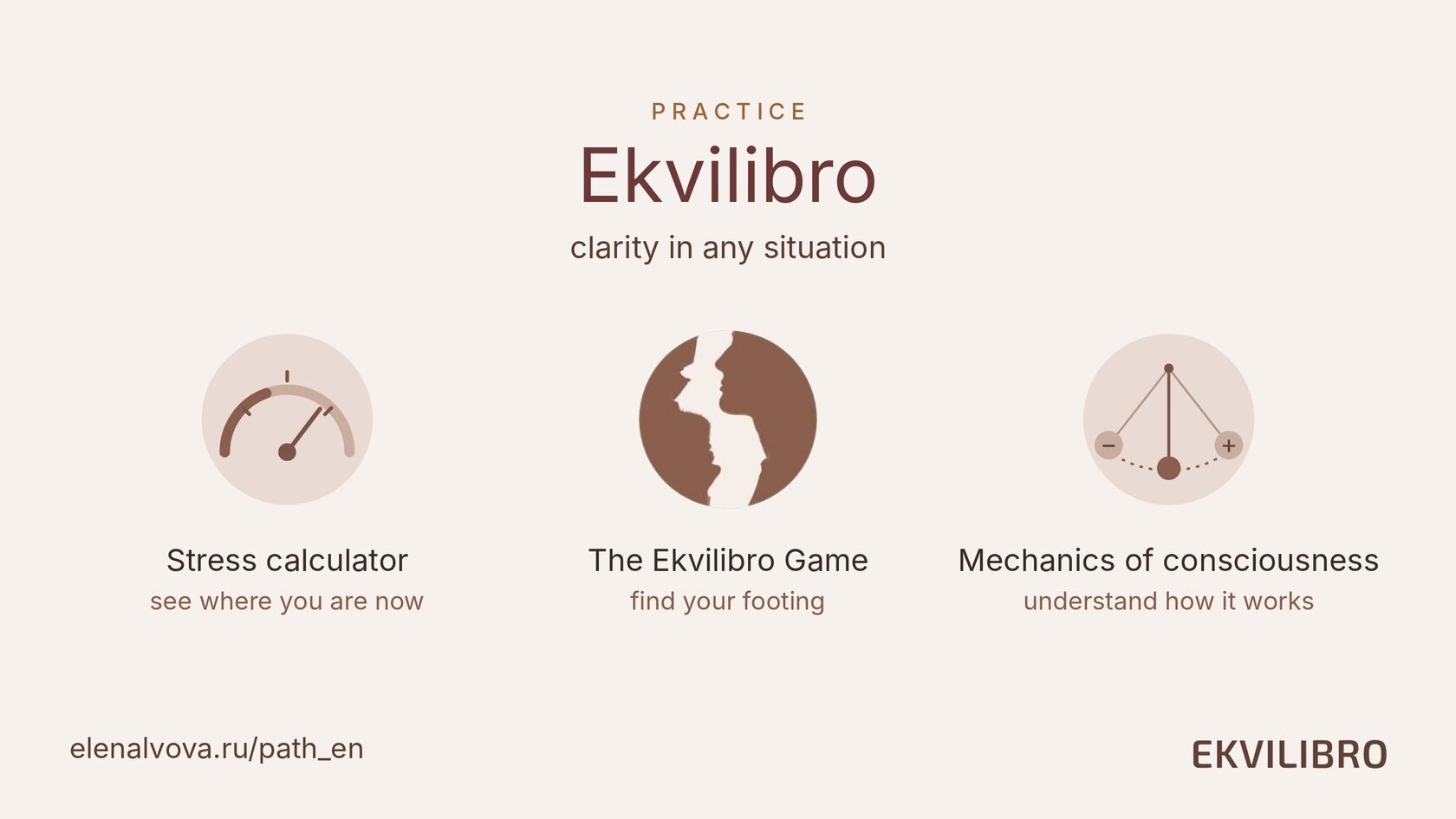
Stress calculator: how much strength the changes of the past year have taken.
The Ekvilibro Game: simple steps to notice automatic reactions and find stability.
Mechanics of consciousness: why reactions repeat and how to choose your state.
Online. No sign-up.
Stress calculator: how much strength the changes of the past year have taken.
The Ekvilibro Game: simple steps to notice automatic reactions and find stability.
Mechanics of consciousness: why reactions repeat and how to choose your state.
Online. No sign-up.
About the author
Elena Lvova is the founder and head of the Ekvilibro center, author of the Ekvilibro system, crisis management consultant and psychologist. 15 years in management and consulting. Author of 12 books (in Russian) and more than 30 scientific and practical papers, from psychology and economics to crisis management and conflict studies.
ORCID iD: 0009-0007-3069-9106
elenalvova@ekvilibro.ru
elenalvova.ru/en
Read also